
What Montgomery County Property Tax Records Show
Two offices divide Montgomery County property tax records, and the line between them is clean. The Tax Assessors Office appraises property, maintains parcel maps, administers exemptions, and sends the annual assessment notices. The Tax Commissioner handles billing, collection, and disbursement of property taxes. Keep those roles straight whenever a value, exemption, balance, or payment looks off.
| Field | What It Shows | Where |
|---|---|---|
| Fair market value | The assessor's estimate under Georgia valuation rules | Assessor parcel card or notice |
| Assessed value | Generally 40% of fair market value before exemptions | Assessor record and tax calculation |
| Exemptions | Approved reductions or classifications applied to the account | Assessor record and notice |
| Bill and payment status | Tax charged, due dates, payments, penalties, or balance | Tax Commissioner account |
| Millage | Tax rates applied by the relevant taxing authorities | Bill and published digest |
| Appeal status | A challenge to value, uniformity, taxability, or exemption denial | Assessor and Board of Equalization process |
A parcel card is not a paid-tax receipt. A tax bill is not a deed either. Get the current document from whichever office owns the field in question.
Separate the Assessor From the Tax Commissioner
Two county offices split the work, and knowing which one does what saves a call. The Montgomery County Tax Assessors Office handles the appraisal side of property records: tax maps, annual notices, sales-ratio work, exemptions, and certain permit records. Its office sits at 303 South Richardson Street in Mount Vernon, reachable at 912-583-4131, with published hours of Monday through Friday, 8:30 a.m. to 4:30 p.m.
The Tax Commissioner takes it from there, handling billing, collection, and disbursement of the tax roll. A question about a fair-market estimate or an exemption belongs with the assessor. A question about an amount due, a payment posting, a duplicate tax bill, delinquency, or a tax-sale status belongs with the Tax Commissioner.
Looking Up a Montgomery County Tax Bill
Use the address only long enough to pin down the parcel. The parcel number is the cleaner cross-reference between the appraisal and billing systems. That matters most for vacant land or a rural route.
- Search the Montgomery qPublic landing page and open the likely parcel.
- Record the parcel number, situs and mailing lines, owner lead, legal description, fair-market value, assessed value, and exemptions actually shown.
- Open the county-linked Government Window tax gateway and search the same parcel or permitted account key.
- Compare tax year, billed amount, payments, penalties, and balance without assuming the assessor's ownership line is current title.
- Ask the Tax Commissioner to confirm any balance or tax-sale status that will affect a transaction.
- Assessed value
- The taxable valuation level before applicable exemptions, generally 40% of fair market value in Georgia.
- Mill rate
- Dollars of tax per $1,000 of taxable assessed value.
- Homestead exemption
- A qualifying reduction associated with an eligible primary residence and timely application.
- Tax lien
- A legal claim arising from unpaid tax, which requires current official confirmation.
Two online routes serve Montgomery County taxpayers. The Government Window payment portal and the direct Schneider parcel search sometimes interrupt visitors with a CAPTCHA or Cloudflare screen. Those are access barriers, not missing records. Retry in a standard browser or call the right office.
Read the qPublic Search Fields Carefully
Montgomery's live search runs on the qPublic platform. That platform commonly offers owner name, location address, parcel number, and legal-information search modes. Confirm each option on Montgomery's own live form before relying on it.
| Search mode | Practical input | Verification step |
|---|---|---|
| Location address | Street number, road name, or a range if supported | Confirm situs line and parcel number |
| Owner name | Surname, entity, estate, or trust variant | Confirm with the latest recorded deed |
| Parcel number | Exact letters, digits, and leading zeroes | Match bill and legal description |
| Legal information | Subdivision, lot, block, district, or acreage clue | Retrieve the deed and plat |
The project capture below leads to the official assessor system and its published-digest notice.
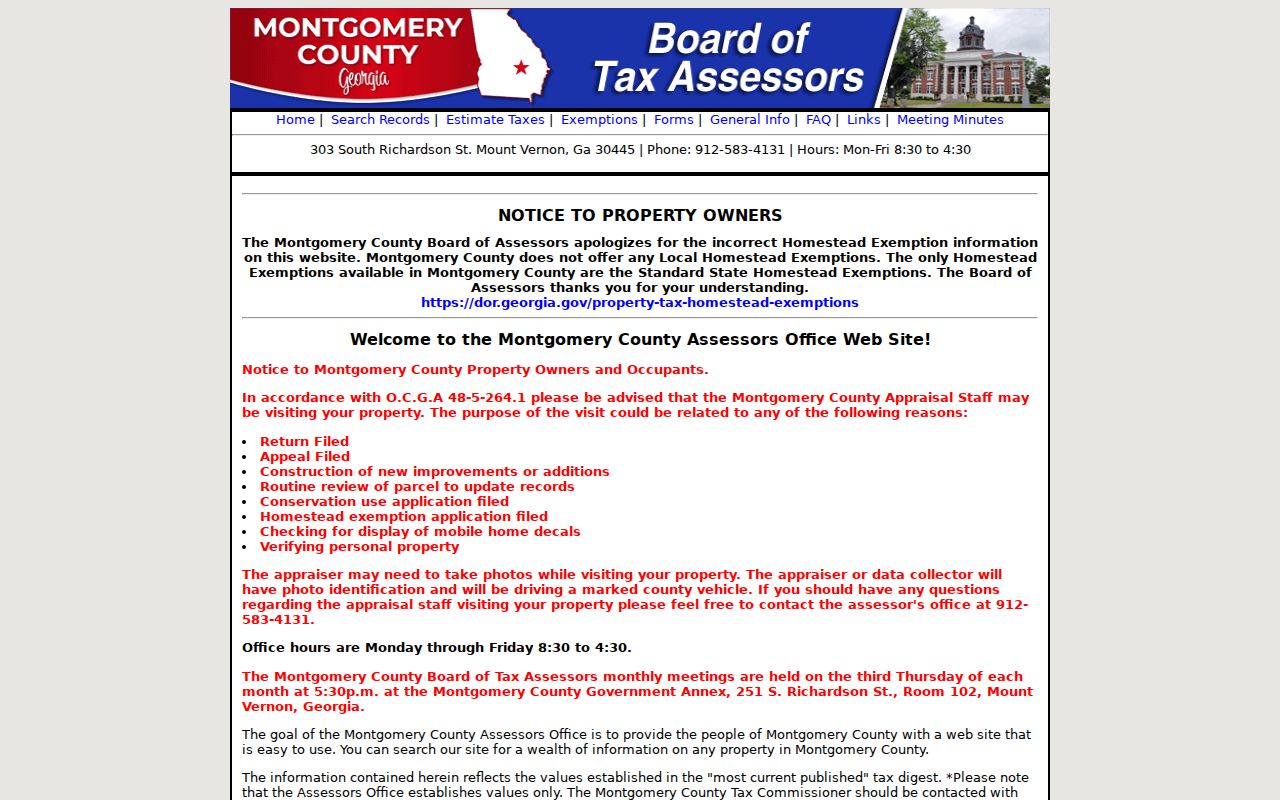
The landing page is an official route in. Check the exact fields and the latest parcel-card refresh there directly.
Apply Georgia's 40 Percent Assessment Level
The Georgia Department of Revenue defines fair market value. It is the price a knowledgeable, willing buyer and seller would reach in an arm's-length transaction. Statewide, Georgia assesses property at 40% of that figure. The simplified formula is assessed value minus exemptions, multiplied by millage. A $100,000 fair-market estimate would ordinarily yield a $40,000 assessed value before exemptions. That illustration is not a Montgomery County bill. Exemptions must still be pinned down. So must the taxing districts and mill rates for the parcel and year.
Keep the numbers distinct. Fair-market value, assessed value, taxable value, deed consideration, and an independent appraisal answer different questions and may have different effective dates.
Use the 2019 Through 2024 Digest as County Context
Montgomery County's published five-year digest history offers a rare countywide benchmark. Gross digest climbed from $209,899,266 in 2019 to $244,386,964 in 2024, while the net digest rose from $180,051,130 to $218,726,728. Real and personal values together moved from $196,939,659 to $232,182,913.
| Digest item | 2019 | 2024 |
|---|---|---|
| Gross digest | $209,899,266 | $244,386,964 |
| Net digest | $180,051,130 | $218,726,728 |
| Real and personal | $196,939,659 | $232,182,913 |
| Mobile homes | $2,074,195 | $3,085,515 |
| Timber at 100% | $6,688,852 | $6,032,146 |
The 2024 disclosure lists gross maintenance-and-operations millage of 17.3940, a 2.5370 rollback, net M&O millage of 14.8570, and $3,249,623 in taxes levied. Those totals say nothing about one parcel's trend, tax, or value. Treat them as county context only.
Account for Mobile Homes, Timber, and Rural Parcels
Montgomery County's digest separates mobile homes and timber from conventional real and personal property. The assessor also inspects mobile homes. It issues building, mobile-home location or exit, and timber-harvest permits. So a property tax search here may need more than a house address. For acreage, keep the APN handy. Keep the tract acreage, Georgia Militia District, road, subdivision or landowner reference, and any timber or mobile-home identifier handy too. An E-911 address can tie a structure to emergency routing, but it establishes neither ownership nor tax classification. It also does not create a surveyed boundary.
Check Homestead and Current-Use Forms
The assessor administers exemptions. The Department of Revenue forms page supplies the statewide applications and instructions. Confirm eligibility, filing dates, ownership and occupancy rules, and local documentation with Montgomery County directly. Do this before counting on an exemption. Current-use valuation and other special classifications are not ordinary homestead exemptions. A reduced taxable value can carry qualification terms, covenants, use requirements, and possible penalties. Ask for the application, approval status, and effective tax year. Ask also about any recorded covenant on the land. Note: The tax bill shows the exemption applied that year, but it does not prove eligibility survives a transfer or use change.
Appealing a Montgomery County Assessment
The annual notice of assessment is what triggers a value appeal. Georgia's PT-311A instructions set a 45-day filing window from the notice date. Grounds include value, uniformity, taxability, and denial of an exemption. That window is strict. The state's appeal page spells out the deadline guidance.
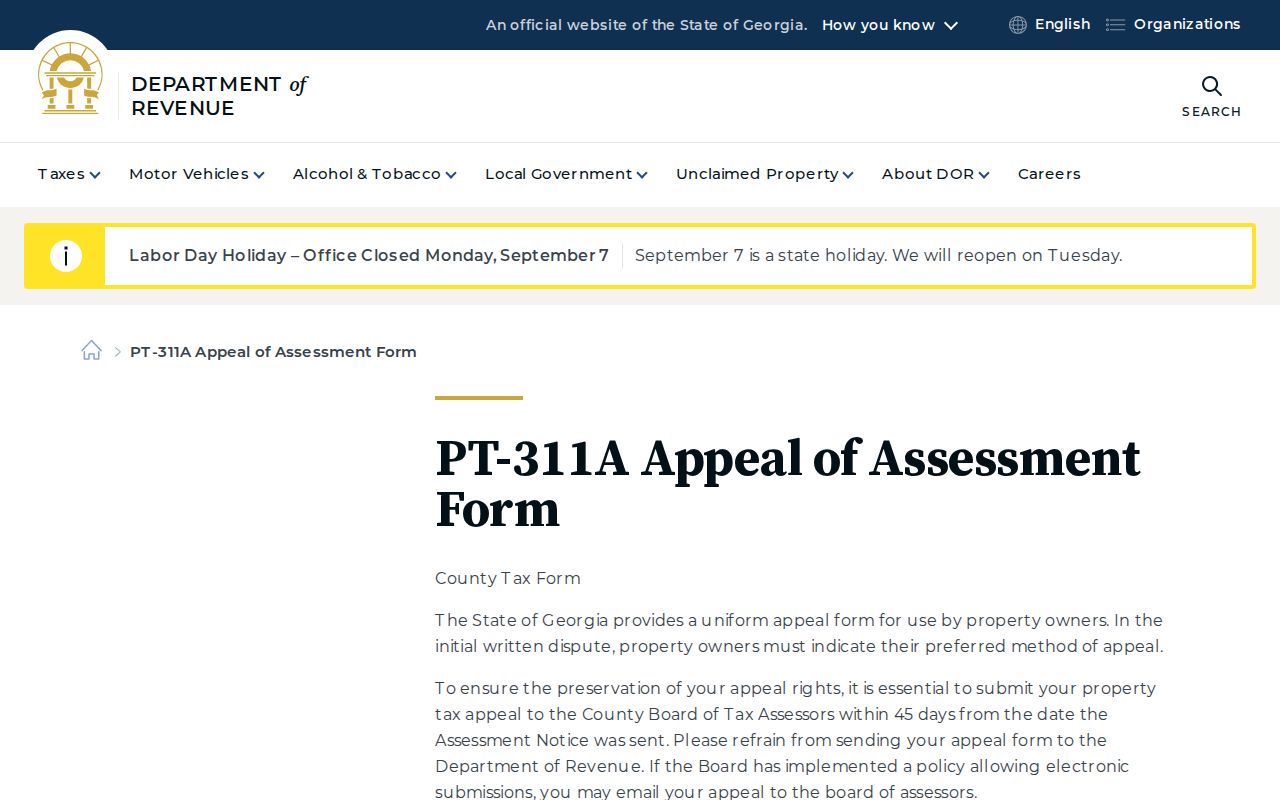
File with the county Board of Tax Assessors using the current instructions. Preserve the notice, envelope, parcel card, comparable evidence, photographs, deed, survey, and a date-stamped filing copy.
Appeal window. Count the 45 days from the assessment-notice date, not from the bill date or the day the property owner first reviews qPublic.
Prepare for a Board of Equalization Hearing
The Montgomery County Board of Equalization decides property-value disputes along with taxability, uniformity, and exemption questions. Clerk support is available. Hearings are open to the public. Because an appeal in Montgomery County must follow the routes and deadlines Georgia law sets, check the current procedure before you file.
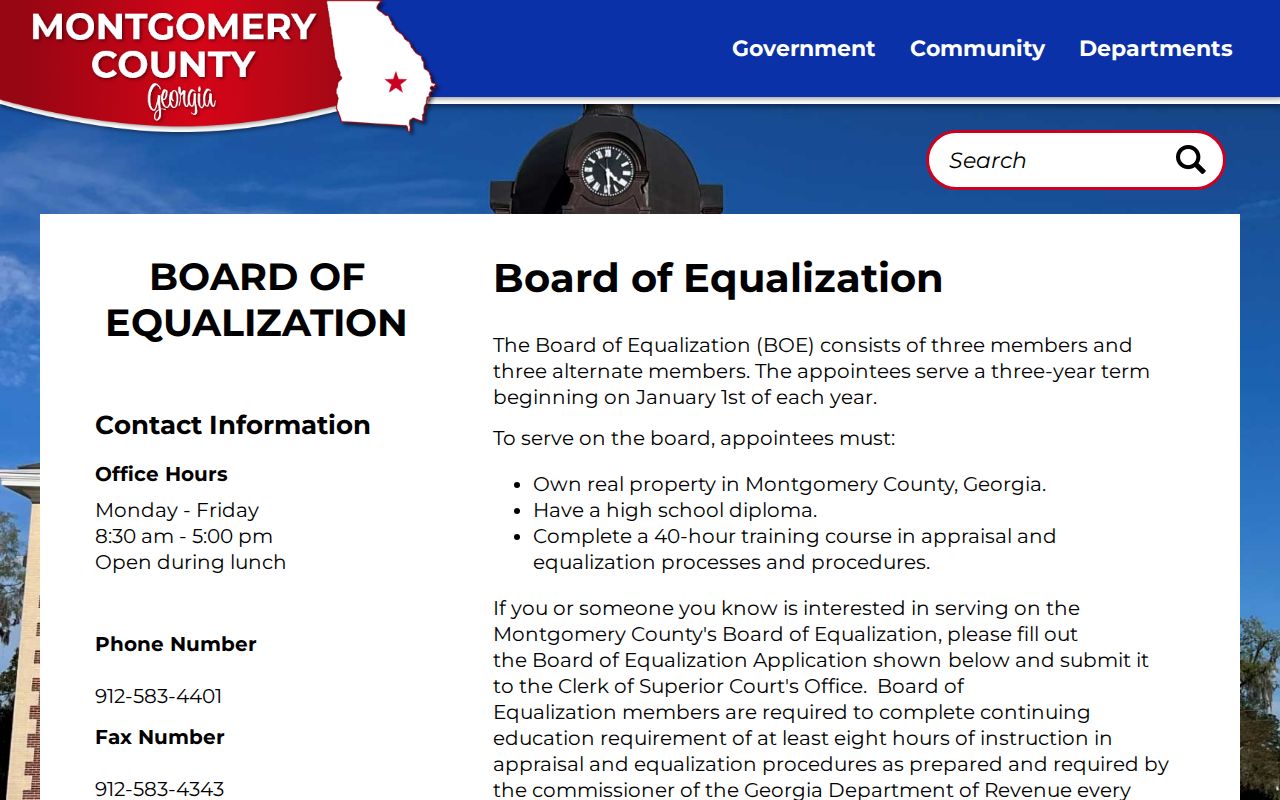
Sort your evidence by tax year and by issue. Comparable sales must be truly comparable and match the valuation date. Repair estimates and photographs should document a condition that existed on that same date.
Verify Delinquency and Tax-Sale Status
A legal notice carries useful clues. It may list a parcel number, a record holder, tax years, and the amount due. It can also show a deed citation, district, or lot-and-block description. Montgomery County examples include Ailey parcels with numbers beginning 017B. Uvalda's Denmark Subdivision Lot 33, parcel 042A029, is another. That one ties to Deed Book 46 at page 464.
Treat the notice as a dated lead. Get the current balance and sale or redemption status from the Tax Commissioner. Ask the Clerk for the recorded tax deed, any release, or later conveyance. Remember that the notice amount is not a market value, an appraisal, or a current payoff.
Know What a Tax Balance Cannot Prove
A zero balance only means the displayed account and year show nothing due. It does not rule out liens, omitted years, special assessments, pending corrections, or title problems. A delinquent balance, likewise, cannot say who bears legal responsibility under every private contract. Montgomery County property tax records are a starting point, not a verdict.
Before a transaction, weigh the latest assessor record. Weigh a current tax certificate or office confirmation too. Add recorded deed and liens, and any closing or legal review the deal requires. Tax records support due diligence. They are not a title search or a boundary survey.
Save the date of your search and a copy of the displayed tax year. A payment, exemption, transfer, split, or correction may still be pending. In that case, ask the responsible office for a written current explanation. That dated confirmation beats assuming an undated screenshot reflects the account at closing.
One more check matters. Confirm the account covers the whole legal tract. Do not settle for a single piece created by a parcel split or combination.